skip to main |
skip to sidebar

Image by Michael Myers
'Paternity', is the story of Pip, a feisty young Australian investigative journalist who wants to know who her father was. I posted the entire book in episodes on Journeys several months ago with a great reaction from thousands of readers.
I've decided to re-post the first episode today and readers can follow the rest of the novel via links on my sidebar. Why should you miss out? Begin following Pip's story now ...
LINKS TO OTHER EPISODES ARE ON THE SIDE BAR
PATERNITY – A NOVEL Part One
© June Saville 2008
They waited with some sort of bizarre discipline, although straining at the leash.
The vicious wind set leaves scuttling on the ground, and branches arching against the bright night sky. The full moon saw it all, and intensified the shadows at the bases of the trees. She felt freezing then, and fear took over from the anger. What did they intend with her?
Soon two white lights shattered the gloom, appearing first at the top of the track. They followed its bends and twists until they lit the clearing and then the target directly … blinding her.
The car door slammed once.
By age 22 Violet Selene Holmes, yoga fanatic, had saluted the sun in a dozen different countries. She draped her long limbs on the sand at Goa as the saffron sun swelled above the Arabian Sea, and, less comfortably, on mountainsides in the Andes, the Himalayas, and among the Kurdish sheep on the slopes of Mount Ararat.
Her mother named her after a flower, and an old fashioned one, although Violet was anything but a delicate petal. Given the choice between a rough pebble-strewn path and a smooth one, she’d take the pebbles.
Her second name was borrowed from the moon goddess of Greek mythology. This was Selene's favourite, and she used it throughout her life.
Selene paid for her fares from a cache she began collecting at age seven, and she travelled alone. But she knew how to party.
She had been roaming for three years, luxuriating in the sights and sounds and smells of other lands, when her thoughts turned homewards. Selene found herself longing for the toss and tumble of a Sydney surf, the smell of eucalyptus leaves burning in a barbecue fire, for streets clogged with Australians — whatever their hue, whatever their accent.
So the young woman with the wheat field hair booked a flight home and did those things which had set her aching while on foreign shores. She steeped herself in old friends and familiar places, but a year or so later she felt again the old need to move along. This time she would explore the vast spaces of her own land ...
The thin strip of gibbers and gravel which had passed for a road for the last two hundred kilometres became wider now and Selene’s hands relaxed on the smooth vinyl of the steering wheel. She could even see signs of desultory attention from a grader. The car picked up speed, rattling by occasional clumps of ancient pine trees, branches gnarled and foliage bedraggled, and spewed dust high into the air. The dust changed colour to red, and eddied and swirled, to settle on the stumps and drunken fence posts on either side.
The town must not be far away.
She took the bend too fast, and had to wrench the wheel to avoid a row of mail boxes on posts set too close to the road. They stood there like abandoned skeletons with no real connection to humanity. Where were the people who got letters in this godforsaken place?
Everything she saw was evidence that people had been there — not that they were there now. A tractor ravaged of moving parts, and rusted. A wattle and daub hut, collapsed upon itself. A lonely sentinel chimney, fireplace attached. Willy nilly tangles of barbed wire, battered baked- bean tins and scattered shards of lager bottles.
The car groaned towards an outcrop of round red rocks lying topsy turvy on a sudden rise. It heaved up the hill, gasped as it came to the top, and died.
In the distance, a small town lay all but concealed on the flat below, as though resisting prying eyes …
Selene stormed out of the driver’s seat and tugged open the bonnet. Her tall frame doubled itself as the fair head bent towards the engine, seeking reasons. There didn’t seem to be any. Finally, she locked the car. Her boots clomped rhythmically, exciting the red dust as she made her way down the slope.
The sun’s glare ricocheted from the galvanised iron walls of a shed dimly labelled War Memorial Hall, and bounced off the road to hit the figure of a soldier dressed in World War 1 uniform, ramrod straight as the gun he held aloft. The cenotaph warrior was the token human being in the place, for the single street was hushed, and empty apart from a clutch of cars shimmering in the relentless light at the far end.
This town was the product of a time tunnel. Small windows of a shop front winked at her, sharing Selene’s delight at its wares. Rolls of cloth, scissors, umbrellas, packets of needles, children’s clothing dangling raggle taggle on wire hangers, and shoes. A battered and cracked mannequin stood proud of her daisy-showered cotton dress, and rubber knee boots. There was a sign on the wall: Closed for lunch.
Next door two small wooden houses leaned against each other, also in siesta.
However, the milk bar was open. The long fake marble counter was coloured with rows of sweet jars, bottles of ice cream soda flavours, stacks of plates and containers of cutlery, all reflected in the long mirror engraved with a likeness of the Parthenon, and swirls of leaves and flowers. An endless row of cubicles with laminated tabletops set with salts and peppers, menus and sugar, lined the opposite wall.
A row of slowly moving ceiling fans hummed a greeting.
‘Afternoon,’ she smiled in relief. The chubby man behind the counter was tied at his middle by the strings of an apron, and his hesitant nod came framed by a moustache, curled and drooping on either side of stacked chins.
‘I’d die for one of your milkshakes — caramel malted?’
‘Just arrived in town?’ He craned his short neck towards the street.
‘My car threw it in at the top of the hill … Lucky to get so close.’
She sat in the corner of one of the cubicles fondling the coolness of the glass, which was thick and squat. The tumbler came empty, accompanied by a tall dented aluminium container filled with creamy milk and froth. You poured the drink into the glass yourself, and there was enough for two helpings. There were no straws, and as she drank, the froth tickled her nose.
The smell and sound of crackling bacon sidled its way from the kitchen, soon followed by the proprietor and a hamburger on a plate. A fly buzzed in his wake.
‘With the lot!’ He slid the plate across the slippery table towards her. ‘I’d have thought you’d be busy … it’s lunch time,’ she glanced around the empty cafe.
‘If you must know they generally wet their whistles at the pub first, and maybe eat later. Watcha here fer lady?’
‘Just wandering. Is there a mechanic?’
‘Gazza’ll probably fix you up. Ask at the bar.’
The clatter in the pub ceased immediately she walked in from the street. Schooners of beer stood ignored among the slops on the bar, and every eye leered in her direction.
'Ladies’ lounge is out the back,’ the barman whined.
Selene chose not to hear: ‘Is Gazza around? I’m after a mechanic.’
The little knots of drinkers, wearing broad hats to a man, stood mesmerised. Then, as Selene stood firm, the entire bar seemed to shift weight from one foot to another.
‘I’m after a mechanic!’
Finally, a mountain of a man extracted himself from the crowd, lumbered over, and breathed a stink of rotten eggs at her. Selene thrust her hand forward to force a greeting and immediately wished she hadn’t. The fellow had hair growing on his palm!
‘Got car problems eh?’ The drinker’s currant eyes flicked over Selene’s jeans where the denim stretched tightly across her thighs.
‘At the top of the hill. It died at the top of the hill … ’
‘Oright. I’ll see ya after I’ve had me lunch.’
Selene drifted into the street just as the last of the sun began to disappear behind a hill. A bed she’d organised at the pub bent in the middle like a hammock, and the shower rose down the hall was broken, but it was all clean enough. Her car was supposed to be on the road next morning.
She thought about the wild ride up the hill in the rusted old ute, engulfed in Gazza’s breath of bad eggs. The mechanic was a soaring suet pudding with cold eyes staring from slanted brows that met at the bridge of his nose. He was impervious to her attempts at conversation. However, once they reached her car he was a changed man: methodical and efficient. To each his own.
That peculiar disinfectant smell of pubs in Australia lingered even on the footpath outside. The barman was hosing down the tiled wall with its mural of brawny footballers advertising KB Lager. He seemed to ignore her, but directed the hose closer as she passed, splashing her shirt. She could feel the damp spreading on her skin.
Where were the women? She hadn’t even caught sight of the ladies’ lounge.
A couple of doors down there was a grocer’s shop with long scrubbed counter and bags of potatoes and onions near the till. Closed. A lone petrol pump outside cast a long weak shadow …
It was good to be in the open air after the smoke and stench of the pub. A full moon sat majestic in the sky, occasionally blotted out by scudding clouds. Washing on a decrepit clothesline flapped with the strengthening breeze …
This place was so silent. The moon withdrew again, and the shadows disappeared as well, becoming one with the sombre darkness.
Close to the cenotaph at the far end of the street Selene paused before an aged building: Guardian Printers. The town had a newspaper! She pressed her nose to a window, opaque with grime. It was now too dark to see anything.
An engine roared somewhere. The moon came out from behind the clouds. She strolled on towards the hall at the edge of town, and then crossed the road. The engine was still roaring. Some hoon trying out his V8. The engine screamed repeatedly, but the car remained hidden.
An abrupt howl and a shriek of tyres, and Selene, startled, stared down the silver road towards the pub. A red Holden screeched into view and was thundering toward her.
The three faces in the front seat of the car gleamed white with the return of the moon. They sneered at her: evil ghosts.
The car propped.
‘Ya fuckin’ cunt. Git in!’
Selene’s body became a spring. She leapt to the side and was running. Her legs were pistons. On foot now, the men clamoured after her, increasingly near and shouting obscenities. The buildings, monsters on either side of the street, mocked her plight.
© The foregoing is excerpted from Paternity by June Saville. All rights reserved. No part of this novel may be used or reproduced without written permission from the author
EPISODE TWO here All episodes are on the side bar.
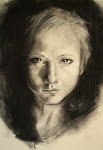
Pip gathered many regular fans over the nineteen weeks that episodes were posted, not the least of them talented Californian artist Vikki North. She was so keen about the story she drew a concept portrait of our heroine and I reckon the picture captures her character perfectly. Tell me what you think as you work your way through the episodes ...

Image by Vikki North
Did you enjoy Part 1? Have you seen a town like this? What will happen next? Have a guess and leave your idea in a comment ... and please leave feedback at the bottom of various episodes as you work through them. We'll have a conversation about your opinions.
LINKS TO OTHER EPISODES ARE ON THE SIDE BAR
EPISODE TWO here
ALSO, THERE ARE MANY MORE OF MY STORIES ON THIS SITE - EXPLORE AND ENJOY!
This is the fifth episode of my novel Paternity the story of a young Australian journalist chasing down the story of her mother's closest secret. So far Pip has visited a country town to discover that her mother Selene had been pack raped there about the time Pip was born ...
LINKS TO OTHER EPISODES ARE ON THE SIDE BAR
And please leave feedback in a comment at the end of this instalment.

The publican was sloshing behind the bar with a mop when they walked up the two steps into the stale tobacco air of the deserted hotel. It was still only 10.30am.
Very much at home, Frank pulled two beers and they sat in the milky sunlight finding its way through the window above the front street. He sat on a stool and reached for his makings.
‘Your mum eh? You told me she died. But does your dad know about this? I mean … can you discuss it with him?’
‘I’ve never known who my dad was. It’s always been a family secret.’ Pip half emptied her beer, despite the hour. ‘Now I’m beginning to realise why.’
Outside, at the bidding of an abrupt flurry of wind, dust rose from the unmade shoulders of the road and placed a film of haze across the town.
‘I reckon … I am the bastard child of a rapist.’
Frank took a long drag on his cigarette and expelled the smoke. Pip’s gaze followed its upward path towards the stained ceiling.
‘I had a gut feeling this town was the key to Mum’s past. Looks as though I was right.’
‘But didn’t your mum marry? Her name’s O’Rourke in the paper, and yours is Holmes.’
‘O’Rourke was Selene’s maiden name, and from when I was a kid she always used the name Holmes. I don’t know where it came from. Assumed there was a link with my father.’
‘Could be, kiddo.’
‘Mmmm. I doubt it … Holmes is the name on my birth certificate, and the bit about parentage was filled in “father unknown”. I reckon she wanted to cut ties with the past.’
‘All of this must have been some shock …’
‘You could say that. Although I knew inside me that it was a secret. Had done for years. You know when not to ask questions. But it was torrid finally seeing it there in official black and white.’ Pip was doing her best to keep emotion out of the conversation.
‘I saw Selene’s certificate for the first time during the preparations for her funeral. There was an addendum stating she changed the name from O’Rourke to Holmes by deed poll in early 1976.’
‘And you were born … when?’
‘March 27 1976.’
For some reason Frank looked puzzled.
One of the town drunks stole into the bar, eager for his first fix of the day. The publican had taken up his post behind the row of beer taps. Frank began to roll another fag.
‘She probably hoped people would assume she was married. They were pretty rough times for unattached women with babies.’
‘Selene made the name change only days before my birth, eight months or so after the attack.’
A dog fight began in front of the grocer’s shop two doors down.
‘Can I have another beer Frank?’
‘Sure …’
A warm sun was throwing stumpy shadows towards the east by the time Pip had again settled into the Guardian office chair. She was scouring more old papers and jumped as Frank burst from the inner room with another yellow-brown file.
‘I can’t find a story on the committal hearing, but will the trial do?’ With a grin.
‘Do? You beauty!’
‘It must have become big news around here. To send a reporter over to the District …’
Friday, March 5, 1976. Pregnant Woman Faces Alleged Rapists. Pip felt her stomach knot.
‘The Western District Court public benches were crowded this week as a pregnant woman faced three men she accuses of gang rape. The woman, Selene O’Rourke 22, of Sydney, alleges the men forced her into a car and drove to an isolated clearing in bush land before viciously assaulting and raping her.’
Pip looked up through a mist of tears.
‘Imagine how she must have felt,’ she whispered.
Frank laid a bony hand on her shoulder, then craned forward to read further: ‘The charged men are all local residents. They are …’
There followed the names of three men.
The old journo began using a match to compact the tobacco in his latest home made cigarette. He seemed very deep in thought.
‘See Editorial page 4.’
Pip turned the pages: ‘The matter of blame in a rape case is never black and white. Questions should always be asked about the degree of provocation. Why was a woman walking alone at night on a dark and lonely street?’ The editorial writer boomed.
‘The Press Council would really like to see that one. Political incorrectness! These people give me the shits. It’s always the woman’s fault isn’t it.’
Pip was abruptly aware of increased tension in the air. She stared across at her former boss.
He was looking at his nicotine stained fingers.
‘You know them, don’t you!’
Frank wouldn’t look at her: ‘Yeah. Two of them. I’ll look into the third bloke for you. Later.’
In the pub an hour afterwards, Frank shook his head as a young barmaid offered a tray of snacks, but Pip reached for a couple of small sausages. She dipped one into a pool of red tomato sauce, placed it whole between her teeth, and began chewing absentmindedly.
‘Nothin’ like “little boys”.’
The old journalist’s smile was forced.
Pip wasn’t listening: simply gaining comfort from eating something; anything. The three names in the newspaper story swayed in her mind’s eye. Those men were scum. They had dishonoured her mother and they should pay.
Pip ground the second sausage to a pulp and turned to her companion. ‘Who are those bastards Frank?’
‘Well, you’ve already met one of them … Dwight Garry Bullfinck, 23 at the time of the rape. His mother must have got the name from a Yankee television soap. He’s a prick.’
In one gulp Frank downed the rum chaser he’d lined up, and dealt with a straying drop of the brown liquid with the back of his hand.
‘All brawn: a violent bugger. Got a wife and four kids he bashes regularly. Seems two bob short of a quid most of the time, but I reckon he’s got plenty of hidden monkey cunning.’
He began on a second beer.
‘The town tolerates him because they’re always short of forwards in the League team. He still plays now and then, even though he’s a bit long in the tooth. And he’s the only mechanic for miles. Yep. He’d be the biggest ugliest prick around.’
‘You don’t mean?’ ‘Spot on. Gazza.’ Gazza. She shouldn’t be surprised. That oversized slob looked as though he was created to rape.
She glanced towards the stool, now empty, that the giant called his own. Dust motes swirled in sunlight playing on the torn brown vinyl. It was too early for him to be at the pub.
Pip’s thoughts were still spinning. Gazza had known Selene. He’d ravaged her. He’d tortured her and used her. And here he was walking in the open world, taking part in life. And Selene was dead.
Her eyes locked onto the red and gold carpet.
There was another part to this equation. Could Gazza … ? No. Could he? Her desperation must have shown …
‘No way he’s related to you Pippin … “ There was a softness in Frank’s voice.
Pip brushed his arm in gratitude.
‘Keep away from him kiddo. Do your investigatin’ from a distance.’
Her index finger toyed with a pool of spilt beer on the tabletop. She nodded. Pip knew it was good advice, but she was damned if she’d allow that monster to dictate what she did.
‘The other bloke I know is George Wimpole. I know George.’
‘And?’ Pip scanned his face for reactions. Clues … ‘A nerd. Seems a nice enough cove. I wouldn’t have said raping was his thing. Far from it, in fact.’
‘Go to hell Frank!’ There was bile in her throat. How could a rapist seem ‘a nice cove’? What was he on about?
‘Slow down mate. I’m just givin’ you my impressions. And we don’t know if he was found guilty. Just charged. We haven’t read the evidence yet remember … Cool it eh? Stop jumping to conclusions.’
Frank struggled off his stool with several empty glasses. Pip used the chilled edge of her schooner to wipe away some beads of sweat on her top lip.
Perhaps she shouldn’t be so hasty, but a rape is rape. And her mother would not have made allegations without good cause. Frank was back with two ten ounce glasses this time.
'Wimpole works in a one-teacher school in a little place a few miles from here. Keeps himself to himself outside school hours. Not married and a sister in London. She’s his only family.’
A chipped and dirty mirror on the opposite wall threw an image back at Pip. An image she couldn’t readily identify as hers …
‘We could go and visit. I could introduce you to him … I’ll have a go at arranging it.’
Pip tripped over the doorstep as she left the bar.
The café cum milk bar was one of those Greek affairs that used to be part of so many Australian outback towns. As was usual, this one stretched long and thin away from the road, its walls lined with rows of tables and benches in alcoves, often empty.
Pip’s walk down the road was prompted by an aversion to the style of food meted out at the pub. The moistness of the Greek souvlaki passed her by although by this time there were two empty skewers on her side plate, and she was working towards a third. As always food was some sort of comfort to Pip, and tonight an unconscious accessory to thought.
How could she ever come to terms with any connection between Gazza and her mother?
She’d met men of his type during a stint as court and crime reporter and placed them in a file labelled Unreal. She had never imagined that such rabble could enter her own life.
And what about this Wimpole? And the third rapist, named ‘Raven’ in the newspaper story? Frank hadn’t known anything about him.
Pip picked up her fork and toyed with a piece of lamb then thrust the plate aside. It was good to be alone though. And she needed a break from alcohol.
Frank was a great friend and she was pleased he was here to help out. However, it was a worry that Flo wasn't around at the moment because she had always had seemed a steadying influence on him.
Frank had been so vital when they'd worked in the city together. Now the edge had come off his good looks and air of self assurance and the ready access to grog wasn't doing him any good at all.
Pip came back to the present and look around the Greek restaurant ... Half a dozen tables separated her and the only other customers, a family group of four she’d passed in the upstairs hallway of the pub an hour before. The farming parents and the young boy and girl were murmuring their way through mixed grills, and posed no threat to her solitariness.
One other person was seated at a table in the far corner at the rear of the room. He was a plump old Greek stamped with a drooping moustache and as she watched, his son the waiter placed a large plate of olives and cubes of feta cheese before him. Their shared appearance and the young man’s respectful concern removed any doubt about the relationship between the father and son.
Pip began thinking of home. Would it ever be the same again? Without Selene, and knowing what she did now?
A moment later the bulbous waiter was at her side. He cleared the table and wiped down the plastic top with a dubious looking cloth.
‘Can I help yous to anything else?’ Pip came back to the present. ‘A short black coffee thanks. Strong.’
When it arrived, the dark brown liquid had muscles.
‘Thanks I need that,’ she smiled, and leaned forward. ‘You might be able to help me. I’m from a Sydney newspaper doing a story about the football tragedy … with that young boy?’
‘Yeah …’ ‘I think I might be able to help the town. You know … get a bit of media attention and maybe an increase in the local health budget. I saw on the pub notice board there was a meeting of the football club, but it didn’t say where.’
‘Yeah. Tonight, down at the hall.’ The fellow’s previously languid moustache twitched. ‘Get some money for the hospital ya reckon?’
‘Well. I hope so.’ The waiter glanced around the café, then wedged himself onto the bench at the opposite side of the table. ‘
‘Look. You know the young guy that was killed? At the football?’ ‘Mmmm …’ ‘Well, that’s his mum and dad. His family.’ Conspiratorial, the waiter nodded towards the family of mixed grills.
This was a breakthrough.
‘Great. Do you think they’ll talk to me?’
‘I dunno. People don’t like the media ‘round here. We like to keep ourselves to ourselves.’ He pulled his moustache to its full length, then allowed the hair to spring back to its normal shape.' S’pose you could try.’
Pip took another look at the family. They’d finished their food and had been tucking into cups of tea, with milk shakes for the kids. The father, as broad as he was tall, had a great thick chest and short arms. His wife was broomstick thin and wore a squashed felt hat from a scarecrow’s wardrobe. The kids were all freckles and scabbed knees.
She took a deep breath and slid out of the alcove. Pip hoped her smile was wide and friendly.
‘Hi. I’m a journalist from a Sydney newspaper. Do you mind if we have a chat?’
The adult faces closed down on her, and became as impenetrable as bank vaults. Then the father stirred. ‘Go to hell lady. We don’t need any of your bloody publicity.’
‘I want to help,’ she gagged. ‘We might be able to get some money for the hospital.’
Pip felt a fraud. She wanted to use these people for her own purposes and until five minutes ago hadn’t given a thought to helping at all.
‘Shove orf!’ the man yelled, then muttered, ‘C’mon, let’s get out of here.’ And directed his flock of dumb struck chickens into the street.
Pip stood in the middle of the café, abandoned.
Instinctively she dropped back into her alcove and, when she caught the eye of the intensely curious waiter, ordered another coffee.
‘I warned ya.’ The waiter’s expression was almost imperious. ‘We don’t like outsiders much around here.’
‘Well, I have to keep trying. I’ve a job to do. What time’s the footy meeting?’
To even consider attending the football meeting cold turkey, without preparation or introductions, was probably quite mad under the circumstances. She’d approached this assignment arse-up, giving her personal problems priority. Now she was stuck with the consequences.
The meeting was tonight and she had no time to lose.
A single street light illuminated the cenotaph with its statue of a World War I soldier, obligatory in so many Australian towns, and extended its feeble gleam to the rusting iron walls of the nearby Memorial Hall.
Pip had only walked two hundred metres from the café but paused to take a deep breath before entering the hall lobby.
There was an empty ticket office on the right and through the internal doorway she could see a collection of plastic chairs at the other end of the large main room. The walls were unlined, skeletal support timbers naked to the eye, and a dozen or so sticky old fly papers complete with old dead flies dangled from the ceiling.
Some local families were sprinkled in small knots around the lightly polished wooden floor. She stood at the edge of the bright light, hesitant and looking for a familiar face. The mixed grills were in the larger group to the left. The cluster on the right had to be the best bet.
Mercifully a beaming smile extracted itself from the group and moved in her direction. It belonged to a small pumpkin on chunky legs - a man who was obviously determined to please.
‘Hello. What can we do for you?’ The man’s eyes swept Pip for clues, then held out a pudgy hand.
‘Harold Staunch, club president.’
Pip breathed easier. She’d found her key contact.
‘Mr. Staunch. Pip Holmes from The Daily,’ she injected friendship into her eyes and pumped the proffered hand.
‘I’m here to write a feature story on your town’s health problems … made so obvious last week with the death of young Jim Rouse. The paper believes some publicity could help prevent similar tragedies in the future.’
‘Excellent Miss Holmes. Excellent.’ The man was positively beaming. ‘I’m also the retired doctor, so I know about the shortcomings around here. Delivered most of the babies in town for the past forty years.’
Pip settled herself to listen …
‘My practice disappeared when the department closed down the hospital. It meant people didn’t come here for treatment and my retirement left the district without any doctor at all.
Now they’ve also shut down the bank, so we’re in one big hole. I’ll help you in any way I can.’
‘Great. You’d be a first class interview for me then. Can we talk later?’
Staunch nodded agreeably.
‘I’m afraid I didn’t make a good start with the Rouse family. We met down at the café, and he didn’t want anything to do with me.’
‘It doesn’t take much to get Jesse Rouse offside, especially at the moment. We’ll see what we can do with him. I’ll introduce you to the team coach too. And before I forget, here’s my card. Ring and we can meet somewhere.’
It looked as though she could be off and running. Pip followed the round man as he rolled towards the front of the room.
By this time the crowd had grown and people began drifting to the seating. Two men were in position on the stage. Staunch walked to greet them and motioned Pip to follow.
‘Ms Holmes let me introduce our secretary Jerry Humber and the club coach Jack Tripp. Jerry, Jack, Pip Holmes is a journalist from the city. Wants to do a story on the football accident and our need for additional health services.’
Pip had a feeling of deja vu.
The eye lids of both men became shutters, just as the Rouses’ had done. The bank vault treatment all over again.
Pip’s hand had been in the air, ready to greet the men. Now she let it drop, and surreptitiously rubbed her jeans to rid herself of the sweat from her palms.
Humber turned his back and, looking embarrassed, Staunch pointed to a seat in the front row. Pip hoped it would swallow her up.
The meeting was short — apologies and correspondence through to general business —the usual. There was talk of the need to meet a shortage in club funding, and official condolences were extended to the bereaved family.
Afterwards there were tea and home made cakes, with Pip feeling decidedly ignored. Staunch stood by her until called away, and then she became the proverbial shag on a rock.
What was this town on about? So much for country hospitality …
Pip sought solace in the jam and cream sponge, then helped herself to a mug of scalding tea.
She had a quiet corner in her sights when a steam roller hit her without warning.
The hot liquid flew from the mug and she felt the sting of it through the sleeve of her shirt.
The burning intensified as the cloth stuck to her arm, and she grabbed the sleeve to prevent it sticking even more.
Only when the pain subsided a little did she look for the cause of her woes. Garry Bullfinck was standing less than a metre away, a leer on his face, and beside him, a man she hadn’t seen before.
He was a short tomato stake with a long nose, so uninspiring he begged to go unnoticed. Except that he made Pip’s flesh creep. And he limped severely as he turned and made his way to the other side of the room.
Gazza laughed almost silently. ‘It can be dangerous around ere love. And don’t cha forget it.’
Then he slid away into the crowd. Pip felt an involuntary chill. Of course Gazza was at the footy meeting. How could she have forgotten to look for him?
The foregoing is excerpted from Paternity by June Saville. All rights reserved. No part of this novel may be used or reproduced without written permission from the author.
GO TO EPISODE SIX
I think Pip's work as a journalist to find a story for her paper illustrates the hit-and-miss nature of journalism. There are so many worthwhile stories happening in the world but so often it's a matter of chance whether they gain appropriate attention.
What do you think about journalists? Do you believe everything you read in the newspapers?
Please tell me in a comment.



 Posts
Posts


