
'and then we got into a labyrinth,
and when we thought we were at the end,
came out again at the beginning,
having still to seek as much as ever.'
- Plato
It is a particularly dark and still February night in harbourside Sydney Town, a scorching airless night where hundreds of souls toss and turn on beds of straw and rags, wishing for the southerly to come and ease the heat, the latest of their discomforts.
Look close through the gloom to see outsize rats skitter from nearby docked ships. See them nuzzle the rubbish in streets and backyards, and watch them scamper through cesspits and ground depressions where foul slops lie.
Venture a little behind the fine facades of Kent Street to find those souls in the tangle of filthy brick huts. Little buildings packed tight in criss - crossed lanes and courts, hidden and forgotten. In rows of seven at a time those huts, stuffed with families and workers sharing four rooms at the rate of sixteen per hut. And them with one tap and two water closets to the row.In one such room a candle flickers, throwing strange shadows about the walls, and lighting six sleeping bodies and another, with eyes wide open, staring.
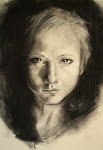
Miriam McDonald is odd to this place, her red hair gleaming. She reclines on the dank straw, the fine cotton fabric of her nightgown stretched against her distended belly. Her long thin hands move to this roundness, stroking gently.
A deep sigh, and a woman nearby throws her arm loose as she rolls in her sleep
.
Listen for myriad other sounds in the night. Groans, and screams and thudding bodies, horse's neigh, ropes strain and slack canvas flaps, distant train whistle. The body collectors trundle their cart.
Against these rough sounds, Miriam sings, oh so low and so sweet, to her coming child.
* * *
They say that the more respectable a family, the less patience is shown if a child should fall from grace. This was surely the case with Miriam’s Momma and Poppa who had worked in the employ of the Macarthurs at Parramatta all of their lives, and their parents and grandparents before them.
Through the years her family had invested much in achieving a good reputation, and were now showing very little tolerance in their daughter’s time of trial. To Miriam, it seemed as though they had thrust her aside, leaving her prey to countless horrors. She would never be so heartless with a child of her own, she whispered.
Mostly she was able to persuade herself that she had done nothing to bring about her troubles, and that there was nothing to feel guilty about. At other times she felt an unease and asked herself if she could have done anything to prevent the catastrophe. Try as she might, she could not condone her parents’ attitude and that made her very determined that she would make her own way, and solve her own problems
.
To be fair, Miriam’s parents were always kind and taught her the niceties of her station, and some accomplishments a little above that. She even played the piano a little, and wrote a reasonable copperplate. Her needlework was not perfect, as she lacked patience in that field, but it was passable.
Those who knew Miriam intimately would note that she knew how to seem docile and agreeable, but suspected that she didn’t always feel that way. Something in Miriam seemed to bubble at times. Some would say it was her nature to speak too loudly and too long. Her eyes did not peep out from fluttering lashes, but gazed boldly. Perhaps this was a predisposition for one with such red hair.
Miriam was eighteen when she first decided to take a path of her own. She'd heard of life outside of Parramatta, and she wanted to live it. It is perhaps an irony that her parents’ careful preparation of their daughter’s attainments smoothed the path to her downfall.
The decision made, Miriam had little trouble gaining a place at one of the more stylish residences in the colony. It is also true that this was made easy because of the connection between the Macarthurs and Lyndhurst. After all, its original owner Dr. Bowman married John and Elizabeth Macarthur's daughter.
Miriam imagined that her parents believed the new discipline would be good for her character, for they had supported her application. So, even when she found herself in a most horrifying and extreme state, because she understood the pain they suffered, Miriam still called her parents ‘dear’.
* * *
To a young girl away from home for the first time Lyndhurst seemed the most dismal and sombre of houses: two storeys with vast high ceilings at both levels, and sprawling on its own peninsular into Blackwattle Cove.
The darkness closed in as the sulky rattled up the bluff. The great bulk of the house threw deep dark shadows over the garden beds, and the leafless trees thrust their branches outwards: threatening and gnarled and ugly.
Miriam discovered herself cringing into the corner of her seat. She dabbed with a handkerchief at small beads of perspiration that had settled on her forehead. To that point she had been excited at the prospect of her new life. What was so different now? She pulled herself together and adjusted her bonnet as the horse clip clopped its way to the servants' quarters around the back
.
For many days the girl with the red hair was tossed on a most turbulent tide. She was a maid, at the beck and call of everyone in the household. Her duties called her to answer to the slightest of whims, dashing through a maze of dark and shadowy rooms at the sound of a bell. She fetched firewood and hot water to the upstairs bed chambers, humped mattresses, and moved furniture from parlour to dining room. She scoured and fetched and carried until exhausted.
Still, in her occasional quiet moments she felt a sense of accomplishment, and an enjoyment with the newness of it all. There were dinner parties and soirees when some of the most powerful people in the colony ventured along the Lyndhurst carriage way to pay their respects, and show their finery.
Always from a discreet distance, Miriam watched the ladies in their elegant gowns, and wondered at the miracle of their tiny waists. She could hear refined voices discussing Mr. Hordern's new emporium and the demise of the skirt bustle in Sydney fashion circles. She noted that the gentlemen vied with each other for the heaviest gold watch and chain, and for the fine tailoring of their black suits. The new Constitution Bill also featured heavily in their conversations.
There was one man Miriam admired particularly, even though his demeanour made her strangely uneasy. Young Mr. Oswin was different from the rest. He remained detached from those milling around the piano, or gossiping on the various sofas. He simply stood quiet, a tall and brooding presence at one end of the room.
A friend of the young master, Mr. Oswin was staying as part of the household. For some days Miriam took any excuse to view his bearing and his languid brown eyes, apparently filled with secrets. She fell to daydreaming about him, imagining him paying her attentions; offering her a posy he had picked from the garden. She imagined him bowing grandly and asking her to dance. She caught herself blushing at the thought.
One evening it occurred to her that Mr. Oswin himself was returning her glances, even though his gaze was more steady and unsubtle than she dared myself. His unwavering gaze became a compelling feature of her life and those eyes seemed to follow her everywhere, quite hypnotic. Miriam would admit that she enjoyed the attention, and on occasions, she even found herself smiling in his direction. However, when she did so, a strange sensation of fear always followed.
* * *
Sharp needles of ice cold pricked her cheeks as Miriam moved through the darkened house, setting things to right before she could retire for the evening. Her hand lingered on the thick velvet of the drawing room drapery, enjoying its softness.
Outside, a gusty wind whipped through the trees on the bay. The dull glint of gaslights played on the buildings of the distant town, then slipped into the bay to shimmer on its restless water. She shivered. And then she turned swiftly to direct the light of her candle towards a subtle movement in the corner of the room ...
The light flickered, revealing Mr. Oswin. He looked strangely uneasy, his frame ramrod straight and his eyes shuttered. He took a step towards her and Miriam’s prickling skin warned that there was something amiss. She reeled towards the door, but Oswin moved closer and his hand was a vice on her shoulder.
‘Be still,’ he whispered hoarsely.
The heavy candlestick clattered to the floor, snuffing its flame. Oswin’s hand stifled her scream and they struggled together, there in the half light. Then for a moment, the girl with the red hair seemed to relax, as though bending to his will.
But then she sank her small teeth into his hand, felt the bone, and tasted warm blood. She broke free, ran to the end of the room and stopped, twisting to meet him.
Blue eyes flashing, Miriam brandished a scoop of red hot embers from the fire.
'Come no closer,' she seethed.
'Now my pretty. You want this. You know you do.' The gold watch and chain glittered at his waist.
'No sir. I do not. Get back. Get back .'For a moment, he turned from her, and then he turned again, to step sideways and behind her small frame, capturing the scoop and her arms in one action.
'You little witch!'He stemmed her cries again, this time with fierce lips, and they rolled to the floor.
The dying fire illumined her desperation.
* * *
The black water of the bay was thick with floating trash. The stench of human waste intensified as she approached the scramble of buildings on the other side of the swivel iron bridge. Lightning bolts split the lowering sky, and she shivered, although the sticky heat was intense.The girl with the nest of red hair bent beneath the weight of her single cloth bag, and her gait faltered.
Sydney Town.
Humanity gathered to crush her in its grip, sweeping her past Sussex Street and left into Kent Street. Leering men and skinny crones, yelling and screaming children, and young women with lifeless faces.
Miriam approached one who sat suckling a child on the wooden steps of a house.
'Roach, ye say? Next lane, fifth on the right.'
The squalor was worse with each step. She fought her way past four children playing in mud, and a slobbering drunk propped up against a wall. Mrs Roach, toothless and gross, leaned in the doorway of a crumbling hut at the end of the row.
'Miss McDonald? They said you was comin'. A wicked girl, they said.'
Wicked. She didn't feel wicked. It was Mr. Oswin who was wicked. Him and his oily ways. Miriam felt the sting of tears as the woman preceded her into a dim hallway, damp with earthen floor and corroding brick walls. Many eyes peered at her as they passed a row of doors lining the hall.
They were the eyes of people prostrate or sitting in semi-darkness, crowded into tiny spaces; people odious- and angry-looking.
'This room's yours. Only five in here, with yersel', an all of 'em females. Think yersel' lucky.'
The hag turned to shuffle down the hall. Miriam wiped the tears with the back of her hand and gazed at her new prison. It reeked of sweat and pain and hopelessness. She placed the bag with her precious possessions on a heap of straw in the corner, and sank down beside it
.
Which way out of this hell hole?
That night on her squalid bed she tossed and then she dreamed. She dreamed of a woman, lone and proud, and her baby nestled in a field of spring flowers and sunshine. Beyond, distant dark figures of apprehension were lost in the mists of time.
* * *
'Have you news of The Plague?' Jenny Entwhistle, a little wisp of a girl, emerged from the shadows.
Mrs Roach was right. There were but four other women in the room. However, she had failed to mention Jenny's two children who also vied for the space: young Beckie, three years-old, skinny stick legs peeping from beneath a rag of a dress, and Grace, thumb in mouth, and snot from her nose rushing to meet it. Never have I seen such miserable little creatures.
'No,' I said absently. 'What, pray, is The Plague?'
'They say 'tis the cause of the most vile illness and death, and that it kills wherever it breaks out. They say a man has died from it in Ferry Lane, in The Rocks. You have na' heard?' The words tumbled into the dismal room.
I shook my head, but Jenny did not pause to take note of it, and prattled on: 'They say he 'ad great swellings on 'is body, and he was vomitin' and shakin' and died in no time, stinkin' somethin' awful. They say it could spread everywhere.'
I was still for some moments, the tangled sounds of human habitation all around. Jenny's panic was infectious.
She now had my full attention, and the room was suddenly very cold.
My baby. I must make my baby safe from this terror.
* * *
I had not imagined such degrading and detestable circumstances existed as those of the Kent Street lanes.
They say the hidden parts of Sydney at the turn of the century were worse by far than the slums of London, of which I had heard whispers often enough. Many people held physical scars, with pock marks, wasting and many other afflictions quite obvious. One man had no legs at all, and bumped along on shrunken stumps. God alone knows how he managed.
Families fought over their differences in the streets, clawing at each other and rolling in the mud in fits of drunkenness. With seclusion so scarce, men and women could be glimpsed coupling within and behind buildings, night and day.
To move in these lanes was to stumble over rubbish and filth; attending to personal needs, such as the washing of bodies and clothing, a constant struggle.
The women in my dormitory had difficult lives. Sarah Campbell, the most determined of them, had taken to prostitution as a way out of her penury. She was an animated skeleton, and most brazen, always taking the Lord's name in vain.
A young woman who thrashed about on the litter next to me had a naturally surly expression made most remarkable by the absence of her left eye. The empty socket glimmered sideways at you, seeming more lively than her real eye, and as black as her soul.
Hannah Simpkins, a thief, was capable of stealing the leg from a donkey.
Paradoxically, my favourite among this brood was a woman who haunted the darkest part of the room. Mary Jones was quite mad, her frenzied dark eyes mostly hidden by grubby tangled locks. She bore her indisposition quietly at most times, venting her frustrations only on herself. She would sit in that corner and scrape away at her arms with any sharp object which came her way, and her limbs were a mess of scars and raw red wounds.
Regardless, she did have a certain dignity which was hard to overlook. I was indeed sorry for her, and did what I could to help in little ways. I wonder even now what dreadful matters came to pass to reduce her to such a plight.
Somehow these people existed here, as much a part of this place as were the cockroaches that crawled around the walls and the floor.
* * *
Jenny Entwhistle had counselled me against walking up fashionable George Street, saying we should keep to Sussex Street which was more to our station. How I wish I had listened to her.
We'd barely reached the corner of Liverpool Street when a group of three larrikins and their girlfriends surrounded us, calling and jeering. Jenny and I huddled in a tight knot, she clutching tiny Grace, and me with Beckie cowering into my skirts.
'Get back to yer filthy holes,' they yelled. 'Ye molls.'
The boys stood there in their flashy bell bottomed trousers and high heeled shoes, arrogant and menacing, performing for their donahs. The girls themselves loved it, in turn parading in their cheap and fancy velvet jackets, a profusion of ostrich feathers fluttering from their hats
.
The circle they formed grew tighter and tighter around us.
The little girls sobbed loudly. I knew I had to act. I straightened my stance and said as haughtily as I could: ‘'What would your parents think of this behaviour? Cease at once.'
In my experience, there is something in the heart of a delinquent which answers to such a response, whether it be shock or perhaps an echo of childish discipline. At any rate, the ploy worked.
They turned on their heels and walked north, yelling as they went."Prostitutes!""Sluts!"
We ignored them as best we could and soon breathed more easily.
* * *
It was Wednesday, rations day at Sydney Benevolent Asylum, and the queue outside the store was exceeding long with sad and ragged people. We would wait hours for an allowance of a little meat, flour, sugar, bread and tea ... supplies for a week.
This will not be my lot in life! The poor house was also the lying-in hospital. It was large and rambling and evoked a distinctly supercilious air, guaranteed to keep the lower classes in their place. Cold as charity, as they say. I would keep my distance for as long as I could, but in the mean time, I must eat.
Jenny and the children entered the store first, but only Jenny herself emerged, clutching a parcel of rations to her chest, with tears tracing muddy paths down her face.
'They took me bairns,' Jenny sobbed. 'Said I wasn't lookin' after 'em proper and I could have no more rations 'less I gave 'em in.'
Grace and Beckie were to go to the Infants' Home at Ashfield, and Jenny could apply for them when she had reached a standard of living fit to support the two little girls.
How could she do that?
* * *
Shrieking whistles ripped the air as we turned the Market Street corner to find that horror ruled.
People young and old, singles and families jostled us and each other, scurrying south in panic and hubbub. They carried everything they owned, tied in cloth bags and humped on shoulders; and with fractured faces.
Officials yelled and screamed orders, carts rumbled, and the picks and shovels of sanitation teams scraped and scratched at the great piles of rubbish strewn around the streets. Men carted off the muck and ordered the scrubbing and scouring of hovels and the drains and lavatories surrounding them.We struggled on to our lodgings.
A group of men with masks around their faces carried a body between them, on a frail litter. We gagged as its stink submerged us.
The Plague had arrived and we were defenceless against its power.
Jenny and I edged down the hallway to our dormitory, but the space was skint - completely bare of any possessions. Someone had taken our belongings.
As we stood there, gazing in disbelief, I felt a sudden griping sensation, followed by a wrenching agony.
My baby would come, thievery and plague notwithstanding.
* * *
The handcart bumped and bucked as we trundled towards the lying-in hospital, past the George Street cemetery. Its gravestones shone in the light of a weak crescent moon: so many white teeth in the mouth of hell.Aboard the cart, I was largely insensible, my entrails on fire.
The wheels shuddered again at the asylum entrance, and the men encouraged me roughly to my feet.
I almost fainted away in terror then, but made it up the steps. Here a severe looking woman stood, her face framed by a stiff white collar, and lit by a candle.
We moved forward, and I was in a very large dark space lined by portraits of imperious men. The flickering light created strange shapes of the thick furniture, and threw into relief the rectangles of many doors around the perimeter.
As best I could, I followed the woman with her long skirts swishing across the tiled floor, my own steps slower, and faltering.
Perhaps sensing my terror, the matron turned to smile at me.
With surprise I realised that her eyes were kindly, and comforted by her softened expression, I made an effort to settle myself.
My stance became more confident and the pain lessened momentarily.
Whatever lay ahead I was determined to make a good life - for my daughter and for me.
© June Saville 2008. Not to be reproduced without express written permission of the author.
Read about the Bubonic Plague now and see some pics.



 Posts
Posts


